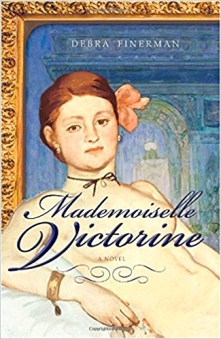
"Mademoiselle
Victorine plunges the reader into the volatile mix of art and
political intrigue in 1860s Paris through the fascinating person
of Victorine Laurent, whose rapid, determined rise from dancer
to courtesan of kings exposes the lives and passions of her time.
Mademoiselle Victorine rides the Parisian whirlwind, taking the
reader so deep into the heart of that glittering and dangerous
era that putting the book down will not be an option."
Pamela
Aidan, author of An Assembly Such As This
Where
book lovers gather, there is always lively discussion. The reader’s guide will help your book club begin the conversation.
Rich
and evocative, Mademoiselle Victorine is a novel of changing
times, of the powerful intersection of art and politics, and
of how one determined woman made her place in history. The
questions in this guide are intended as a framework for your
group’s
discussion of Mademoiselle Victorine.
Reader's
Guide
1.
Describe your first impressions of Victorine and Manet. What
was your initial opinion of each of them, and in what
ways did
your view change as the novel went on? How did it stay
the same?
2.
Prior to reading Mademoiselle Victorine, what did you know about
the French Impressionist painters? Was there
any knowledge
of their
work or lives that illuminated your reading of the book?
3.
How would you characterize the relationship between Victorine
and Julia? Are they allies and friends, or
rivals? If you
were Victorine, how would you feel about Julia, and
vice versa?
Did you find yourself identifying more with one than
the other?
4.
Consider the character of Queen Mabille. What does the old woman
represent to Victorine, and in a larger
sense,
what role
does she
play in the Paris of this novel? What did her story
add to your understanding of the world these characters
inhabit?
5.
Several of the characters in Mademoiselle Victorine came from
wealthy backgrounds, but had shunned their
privileged existences
to live a bohemian life. What does Victorine think
of this choice? Is it something she understands
and accepts?
Why
or why not?
What about you? When you hear of modern-day children
of wealth “giving
it all up” to become artists, what assumptions do you make?
Would any of those assumptions be valid in the case of these characters?
6.
Throughout the novel, Victorine continually reinvents herself
and refines the story she tells
of her background.
What are
some examples of the different stories she tells,
and is there anywhere
you see her getting caught in her own web and
having to shift on a dime when she forgets what she’s told whom? Why do you
think her story is so complex and changes so much? Were there places
you thought she had gone too far, beyond the point of lying for
understandable reasons?
7.
Discuss the character of André. What role does he play
in the lives of those around him? André writes a popular
society column. Did it surprise you that Paris in the 1860s had
tabloids that reported gossip? Can you think of equivalent magazines
or newspaper columns today?
8.
Did Victorine remind you of any other literary or historical
figures? If so, who, and in what
way? Where
else have you
seen the story of a young woman pulling herself
up by her bootstraps
to find herself living at the pinnacle of
society? Of artists’ muses?
Of the courtesan made good? What, if anything, makes Victorine
different?
9.
Were you surprised by the revelation of Victorine’s lineage?
Why or why not? How did this news change your view of the man who
turns out to be her father? Did it change Victorine’s opinion
of him, or her ideas on life and love in general? What, if any,
lasting effect did you see the knowledge of the story behind her
conception and birth having on Victorine?
10.
What do you think inspires Philippe’s ultimate change
of heart? Did the transformation take you by surprise? What effect
does it have on Victorine?
11.
Discuss the portrayal of the leftist rebels in Mademoiselle Victorine.
In
the world of
this novel,
did you find their
cause just? How did you feel about
their methods? What part did the
Communards play in the plot of the
novel, and what did you think of this picture
of them?
12.
Philippe’s liaison with a much younger, beautiful woman
was common knowledge and not socially unacceptable. But when it
became a political liability that threatened to ruin his career,
his actions and attitudes toward Victorine changed. Is this a familiar
scenario? Why do you think political figures of all eras get caught
in such situations though they know the risks?
Book
Club Appearance
Debra
Finerman would love to join the chat when your book club meets
to discuss
Mademoiselle
Victorine. She’d be happy to
answer any questions and hear your comments.
Contact
Debra to schedule a book club phone appearance
©2007
Debra Finerman. All Rights Reserved.
Website design by Chris Costello
|